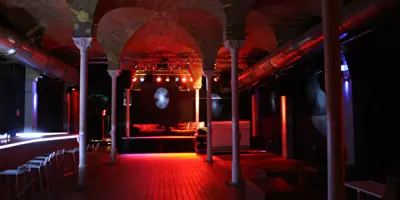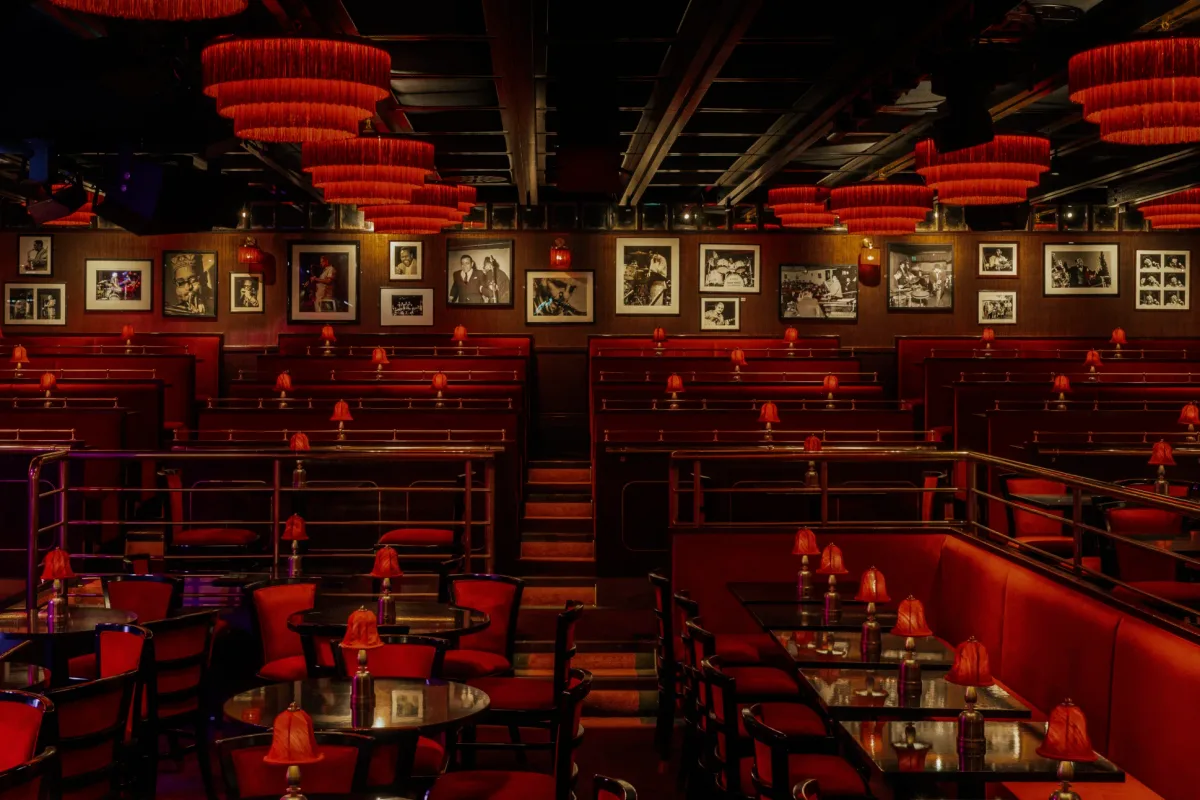
Ronnie Scott's is the Soho basement that London jazz still measures itself against, a club that opened in 1959 above a taxi rank on Gerrard Street before its founders, the saxophonist Ronnie Scott and his business partner Pete King, moved it to its current home at 47 Frith Street in 1965. Jimi Hendrix played his last public performance there in September 1970, and in the decades since, the room has hosted Dizzy Gillespie, Ella Fitzgerald, Nina Simone and Sarah Vaughan alongside a rotating bill of contemporary jazz, soul and funk acts that keeps the stage occupied most nights of the year.
That volume shows up clearly in Ronnie Scott's own listings on Mood: the club logged 48 confirmed bookings in the month running through late September 2026, nearly double the count of the next-busiest room in the same citywide pull. That's a striking number given the venue's size - Mood rates the room just 0.383 on capacity, below London's 0.447 average across the same event set - which points to a small basement running an unusually dense, near-nightly calendar rather than a large room coasting on scale.
A legacy room with a late-night second act
What keeps Ronnie Scott's relevant beyond the history plaques is that its booking hasn't stayed frozen in the bebop era. Alongside the main-stage jazz sets - trios, vocalists, the occasional big band - the club runs a nightly "Late Late Show" upstairs that leans into soul, hip hop and jazz-funk, often starting after the downstairs set wraps. It's how a room built around Dizzy Gillespie's generation now also books DJ-fronted late sets and genre-crossing residencies like Vula Malinga's, without pretending to be something it isn't during the earlier part of the evening.
Mood's enrichment data reads that identity as more polished than experimental: across the venue's booked nights, average undergroundness sits at just 0.232, well below London's 0.366 citywide average for the same period - one of the least underground readings among the city's regularly booked rooms. That's not a criticism so much as an accurate description of what Ronnie Scott's is: a heritage jazz institution built for a night out with a reputation behind it, not a room chasing the scene's rawer or more discovery-first edges.
What a night there actually asks of you
The trade-off for that history is a format built around table service rather than a casual walk-in. Seats are mostly reserved, sets run early and late with a turnaround between them, and Mood's own feature data puts the venue's seating score at 0.804 and dining at 0.794 - both far above London's 0.502 and 0.377 averages across the same pull - which tracks with a dinner-and-show model rather than a standing club floor. Tables carry a minimum spend, prices sit well above a typical Soho bar, and because the room only seats a few hundred, in-demand nights sell out days or weeks ahead. None of that makes it a bad room; it makes it a specific kind of night, closer to a restaurant with a stage than a club, and that's worth knowing before booking rather than after.
Where Ronnie Scott's sits in London right now
In a city where live jazz mostly survives in festival slots or one-off pop-ups, Ronnie Scott's still runs a real, seven-nights-a-week calendar - a scale most London jazz rooms, even good ones, don't attempt. On September 25th the club hosts Ilhan Ersahin's Istanbul Sessions, a jazz-and-electronics project pulling from the Turkish saxophonist's Nublu label. A night earlier, on September 24th, the Trinidadian-British poet and musician Anthony Joseph brings his spoken-word-and-jazz live sets to the same stage - both listed with full details on Mood.
Frequently Asked Questions
Where is Ronnie Scott's located?
Ronnie Scott's is at 47 Frith Street in Soho, central London, a short walk from Tottenham Court Road and Leicester Square underground stations.
What kind of music does Ronnie Scott's book?
Mostly jazz - trios, vocalists, big bands and touring international acts - with a late-night upstairs programme that adds soul, hip hop and jazz-funk after the main sets finish. It's not a venue for rock, house or mainstream chart acts.
Do I need to book a table in advance?
For most nights, yes. Seating is largely table-based with a minimum spend, and popular bookings can sell out well ahead of the date, so checking the listing on Mood before turning up is worth doing.
Is Ronnie Scott's good for a first-time jazz audience or only for regulars?
Both, in different ways. The polish and reputation make it an easy entry point for someone who doesn't normally go to jazz clubs, though listeners looking for a rawer, more underground room elsewhere in London will find Ronnie Scott's leans toward the mainstream end of the city's jazz scene.
Are there other jazz venues in London worth comparing it to?
Yes - London's jazz scene runs well beyond Soho, and Mood's jazz listings for London cover the wider circuit alongside Ronnie Scott's own calendar.