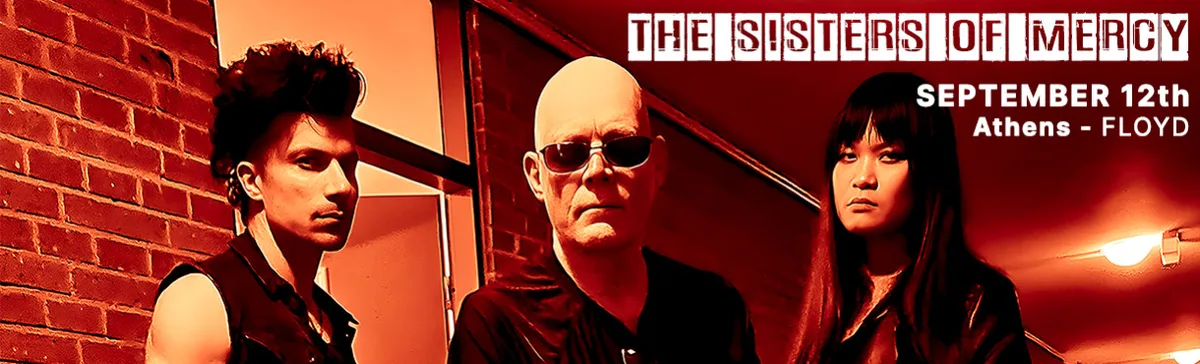
The Sisters of Mercy are the Leeds band that turned gothic rock into a permanent touring act rather than a single sound or era, and on Saturday, September 12th, that show played Floyd, in Athens, built entirely around a discography that stopped growing in 1990. There was no new album to promote, no recent single, nothing beyond the catalogue the band has been touring for more than three decades. Judged as that kind of night, rather than as a discovery show, the Floyd date is a useful test case: what does a band do once it has stopped adding to its own legend and started only maintaining it?
A Discography Frozen in 1990, a Band That Never Stopped Touring
Sisters of Mercy formed in Leeds in 1980, founded by singer Andrew Eldritch and guitarist Gary Marx. Eldritch played drums on the first single before handing the job to a drum machine nicknamed Doktor Avalanche, which has stayed in the lineup through every subsequent change - Eldritch and the Doktor are the only two constants in the band's history. Three albums built the reputation that still fills rooms today: First and Last and Always (1985), Floodland (1987), and Vision Thing (1990). A dispute with the band's record label stalled new recordings shortly after Vision Thing, and no studio album has followed in the thirty-six years since. Instead of a new record, Eldritch kept the band on stages, touring steadily into the 2020s on material that predates most of its current audience.
The Sound at Floyd
Mood's enrichment data reads the Athens show at 0.7 on polish, noticeably above the 0.56 average across the 44 other rock, punk, and gothic-tagged events Mood tracks in Athens across the surrounding two months, and level with the top quartile of that same set. For a band whose founding mythology runs on being confrontational and underground, that is a well-produced, professionally run night by the city's own current rock-and-gothic standard - not the lo-fi one the reputation implies. The room plays a part in that: Floyd's Mood profile shows a mid-sized space built for amplified guitar-forward shows, not an arena stage, which suits a band whose whole live identity depends on close quarters, fog, and almost no visible lighting rig.
A Genre Eldritch Effectively Invented, Read as Just Another Night
More surprising is undergroundness: Mood scores the show at 0.4, essentially identical to the 0.42 average across that same 44-event comparison set - a mix of Greek entehno revivals, metal tribute nights, and indie-rock bills that mostly don't share the Sisters of Mercy's scene pedigree. A band that effectively wrote gothic rock's rulebook forty-five years ago reads, by Mood's data, as no more "underground" today than an average night on Athens's guitar-music calendar. That is not a knock on the show - it is what happens when a genre-founding act becomes an institution rather than a discovery.
Darker Than the Rest of the Bill
Where the show does separate itself is valence: Mood puts it at 0.34, well below the 0.50 average for that same Athens rock-and-gothic set. Of the three readings, it is the one that actually lines up with what the poster promises - a night pitched noticeably darker in mood than the entehno-rock revivals, tribute shows, and indie bills it sat alongside on the city's calendar that week.
Athens' rock and gothic calendar this season leans heavily generational - Vasilis Papakonstantinou and Alkinoos Ioannidis on the entehno-rock side, a 30th-anniversary Nightstalker show, forty years of Mora sti Fotia. Sisters of Mercy fit the same pattern, imported from Leeds: a band now built around sustaining a legacy rather than extending one. On that measure, Floyd delivered close to exactly what a Sisters of Mercy date has delivered for three decades - polished, dark, and entirely uninterested in being anything else.
Frequently Asked Questions
Who played the Sisters of Mercy show in Athens?
The bill was Sisters of Mercy alone - Mood's listing for the Floyd date shows no confirmed support act. The band's live lineup is built around founder Andrew Eldritch and the drum machine "Doktor Avalanche," the only two constants across its history since 1980.
When and where did the Sisters of Mercy play in Athens?
The show took place on Saturday, September 12th, 2026, at Floyd, on Pireos 117 in Athens - a room that regularly hosts internationally touring rock, metal, and post-punk acts.
Has the Sisters of Mercy released a new album recently?
No. Vision Thing, released in 1990, remains the band's most recent studio album. A dispute with their record label stalled new recordings shortly after, and none has followed; the band has continued almost exclusively as a touring act since.
Is the Sisters of Mercy still touring in 2026?
Yes - the Athens date is one stop on a live schedule the band has kept up steadily since the early 1990s, built entirely on its existing catalogue rather than new material.
Where can I find more rock and gothic shows in Athens?
Mood tracks the city's rock, punk, metal, and gothic calendar year-round, from legacy acts like this one to newer local bills - browse all rock and alternative listings in Athens on Mood.
For the rest of the city's live music calendar, from legacy rock to techno and entehno, explore upcoming events in Athens on Mood.