Mood added Tallinn to its catalogue this September, and the shape of its music events sets it apart from every other city the app covers. Of the 714 upcoming music events tracked in the Estonian capital as of late September 2026, more carry a classical, chamber music or choral tag than any single genre in Mood's other new markets carries - a concert-hall identity built around two rooms, Estonia Concert Hall and the Estonian National Opera, which between them host close to one in eight of the city's tracked listings. Folk ensembles, world-music nights, a recurring dinner-cabaret circuit and a smaller, considerably louder underground scene fill out what's left. This guide follows that real shape, not the club-and-DJ template Mood defaults to elsewhere.
Where Tallinn's concert season actually lives
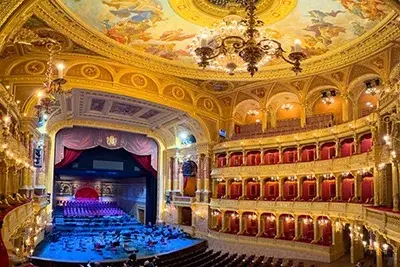
Estonia Concert Hall alone accounts for 70 of Mood's tracked Tallinn bookings this month, more than any other venue in the city by a wide margin, and its programme reads like a state orchestra's touring schedule rather than a single promoter's calendar: the TubIN festival of contemporary Estonian composition opens October 1-2, the Estonian Defence Forces' military band marks its anniversary on October 8, and a combined-choir arrangement of Beethoven's Ninth follows on October 13. A short walk away, the Estonian National Opera opens Janáček's The Cunning Little Vixen on October 8, ahead of a run of My Fair Lady and a staging of Adam's ballet The Corsair. Between the two houses, Mood tracks close to 90 nights of classical and opera programming in October alone - the backbone of the month, not a side track next to a bigger club scene.
The city's second-most-booked room, Alexela Concert House, tells a slightly different story: 49 tracked nights split between classical crossover, classic rock and international touring acts, including a reggae-inflected synthpop night from Laid Back on October 3 and Norwegian folk-metal act Wardruna's Nordic-folk set on October 16. Even Tallinn's concert-hall infrastructure isn't purely classical - it's built to host whatever large-room act is passing through, and this month that includes a black-metal band a few kilometres away, not just a symphony.
The classical circuit doesn't stop at the two flagship halls, either. House of the Blackheads, a medieval guild house in the Old Town, tracks 18 chamber-music nights this month, including a Kolja Blacher recital with the Tallinn Chamber Orchestra and a solo-piano arrangement of Beethoven's Ninth by Liszt. Down the road, the Estonian Academy of Music and Theatre runs its own student and faculty concert series, ACCORDIONFest among them, at 16 tracked nights. None of these rooms would clear Mood's usual bar for a standalone venue guide on their own - but stacked against Estonia Concert Hall, the Opera and Alexela, they show a city with genuine depth of classical infrastructure, not just two marquee buildings carrying the whole genre.
The other stage: Paavli Kultuurivabrik and Tallinn's underground layer
Not every booking in Tallinn points toward a concert hall. Paavli Kultuurivabrik, a converted industrial venue that ranks third in Mood's Tallinn catalogue by volume with 32 tracked nights, runs almost entirely against the classical circuit's grain - hardcore punk, black metal, doom and experimental electronic sets built around STF, the venue's recurring electronic-music takeover series. Polish black-metal act Batushka plays there on October 3, and in Mood's enrichment data the venue's average "undergroundness" score sits at 0.66 - more than double the 0.10 to 0.25 range Mood assigns to Estonia Concert Hall, the Estonian National Opera and House of the Blackheads, the three classical rooms that otherwise dominate the city's bookings. It's a small venue by raw count next to the concert halls, but it's the clearest signal in the data that Tallinn's live-music identity isn't only the one built around orchestras and opera.
Folk, world music and the community circuit
A third layer runs alongside the concert halls and the underground scene: a genuine community folk circuit, centred on Nõmme Cultural Centre in Tallinn's garden-suburb district, which hosts amateur and semi-professional folk ensembles - including the singing club Kanarbik's regular October gathering - alongside touring world-music acts. Folk and world-tagged listings account for 90 and 67 of Mood's tracked Tallinn events respectively, a bigger combined share of the catalogue than pop. What's worth noting is the mood those listings actually carry: in Mood's enrichment data, folk-tagged events average a 0.64 valence score and world-tagged events 0.66, both higher than the city's electronic-tagged bookings at 0.58. Folk night in Tallinn, on Mood's own numbers, reads as the happier ticket than the average electronic one - not the wistful, nostalgic register the genre tag usually implies.
The dinner-cabaret residencies
One more corner of the catalogue is easy to misread on a first pass through the numbers. Mood tracks 63 cabaret-tagged listings in Tallinn this month, more than the 41 tagged opera - a genre most people wouldn't associate with the city at all outranking one it's actually known for. The honest read is less dramatic than the headline number: almost all of it comes from two long-running dinner-theatre residencies, Revüülavastus Cinemania at Restoran Merineitsi (31 nights tracked) and Viru Varietee at the Park Inn by Radisson (18 nights), rather than a broad or varied cabaret scene. Opera, by contrast, spans 38 different productions across its 41 listings - real repertoire turnover, not one show repeating on a loop. The comparison says less about cabaret overtaking opera in Tallinn than about how a single recurring booking can outweigh genuine variety in a raw count.
Find more events in Tallinn on Mood
Tallinn arrived in Mood's app this September alongside four other new markets, and it's the most classical-leaning of that group after Riga. That timing matters for how the catalogue reads right now: a city this new to Mood's index doesn't yet carry the interest-count history that shapes recommendations in older markets, so the numbers above describe what's actually booked, not what local users have already voted for. Mood's Tallinn catalogue keeps updating as new concerts, opera runs and club nights get added through the month - browse the full, continuously updated list of upcoming events in Tallinn on Mood to see what's on beyond the picks above.
Frequently Asked Questions
What kind of music events happen in Tallinn?
Tallinn's catalogue on Mood leans heavily toward classical, chamber and choral music, anchored by Estonia Concert Hall and the Estonian National Opera. Folk, world music, opera, dinner-cabaret and a smaller underground scene built around venues like Paavli Kultuurivabrik fill out the rest of the calendar.
Is Tallinn a good city for classical music?
Yes. Mood tracks close to 90 nights of combined classical and opera programming at Estonia Concert Hall and the Estonian National Opera in October 2026 alone, more than any other genre carries in the city's catalogue. The programming runs from contemporary Estonian composition to full opera and ballet productions.
Are there underground or alternative music events in Tallinn?
Yes, though it's a smaller layer than the classical circuit. Paavli Kultuurivabrik runs the city's main underground programme - hardcore punk, black metal and experimental electronic sets, including Batushka's October 3 show - and scores well above the classical venues on Mood's "undergroundness" rating.
Does Tallinn have live folk or traditional music?
Yes. Nõmme Cultural Centre runs a recurring community folk and choral programme, and folk and world-tagged events together make up a larger share of Mood's Tallinn catalogue than pop. Mood's data also shows these events score higher on average mood (valence) than the city's electronic listings.
Where can I find the full list of upcoming events in Tallinn?
The complete, continuously updated list of upcoming events in Tallinn is available on Mood, covering classical, opera, folk, cabaret and club listings as they're added through the month.